Why AI Solved Chess Before Common Sense
In 1997, a machine beat the reigning world chess champion. In 2026, the best available AI can still occasionally mishear “turn off the bedroom lights.” Those two facts sit oddly next to each other, and the reason why is a genuinely useful lens for thinking about what AI is actually good at.
Ananya Kohli · September 2026 · 8 min read
Not every problem an AI system is asked to solve is the same kind of problem. That sounds obvious once stated, but it’s routinely ignored in both AI hype and AI criticism, both of which tend to treat “AI performance” as one single number going up or down. A more useful framing, and one with a real academic lineage, splits AI tasks into three domains: formal, mundane, and expert. This classification appears in Elaine Rich, Kevin Knight, and Shivashankar Nair’s textbook Artificial Intelligence (3rd ed., Tata McGraw-Hill, 2009), a standard reference in AI coursework, and it still holds up as a way to reason about where current systems succeed and where they don’t.
Here’s the shape of the whole argument before the details:
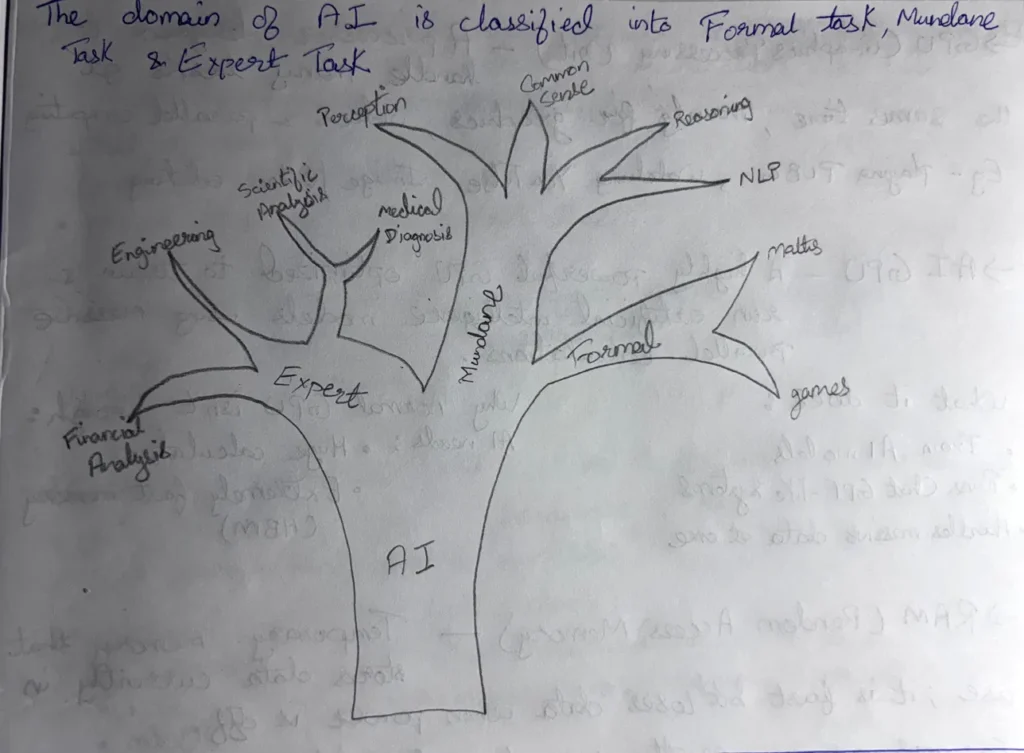
The three task domains, defined
Formal tasks operate inside a closed, fully specified world: a fixed set of legal moves, an unambiguous goal, and a mathematically verifiable notion of correctness. Chess, checkers, theorem proving, and integral calculus are the textbook examples. There is no missing context to infer and no real-world noise to filter out; the entire problem is stated up front.
Mundane tasks are the ones healthy humans pick up before they can talk: perception, common-sense reasoning, and natural language. They look trivial precisely because we do them without conscious effort. But the task itself is open-world: the system has to handle ambiguity, missing context, and inputs nobody explicitly enumerated in advance.
Expert tasks require the kind of judgment that takes a trained human years to build: medical diagnosis, financial analysis, engineering design, scientific interpretation. The math or data involved may be tractable on its own, but the task also demands weighing competing, often unstated priorities the way a domain specialist would.
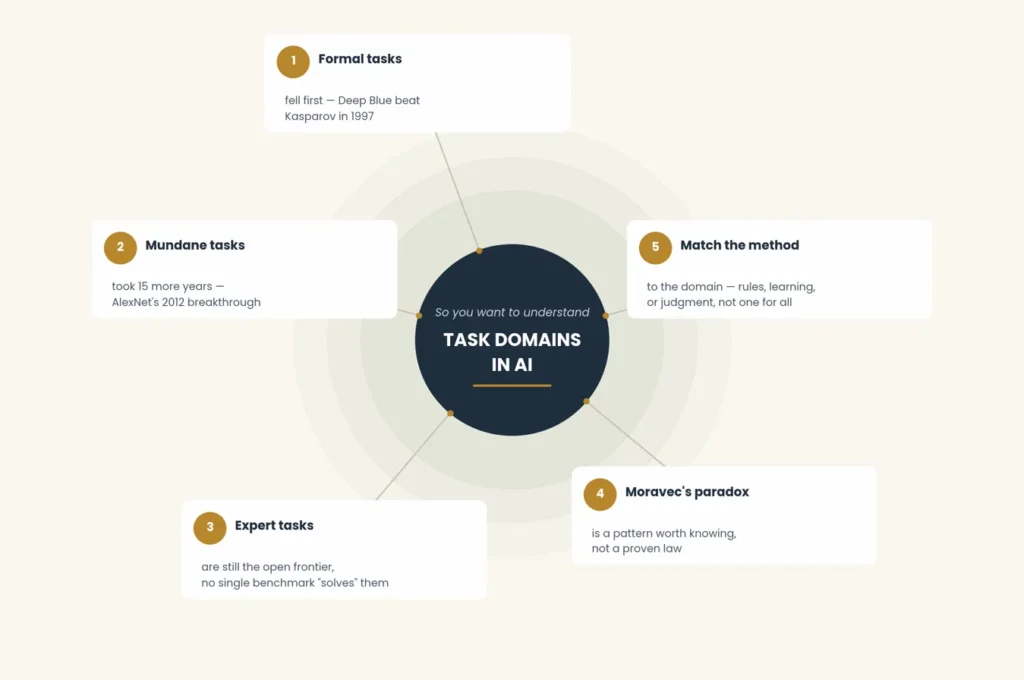
Image by author.
Why the order of AI progress looks backwards
Here’s the part worth sitting with: the order in which AI actually got good at these three domains does not match the order in which humans find them easy.
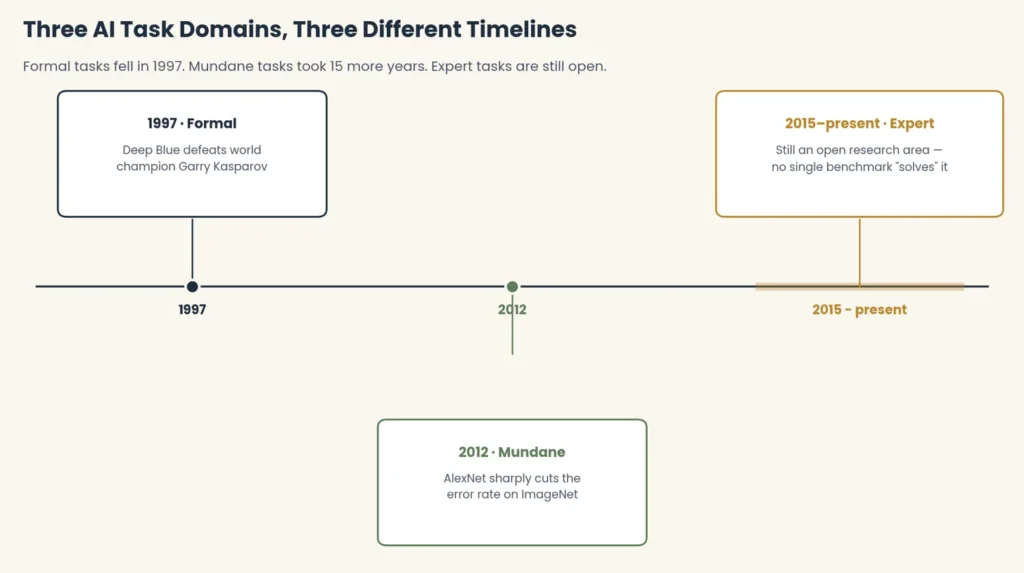
Formal tasks fell first, and by a wide margin. On May 11, 1997, IBM’s Deep Blue defeated reigning world chess champion Garry Kasparov in a six-game match, the first time a computer had beaten a sitting world champion under standard tournament conditions. Formal tasks are tractable early because the entire problem, every legal move, every winning condition, can be specified as a closed set of rules. A system doesn’t need anything resembling general intelligence to search a well-defined game tree exhaustively or near-exhaustively; it needs computation and a good evaluation function.
Mundane tasks took roughly fifteen more years to see a comparable leap, and the breakthrough came from a completely different kind of system. In 2012, Alex Krizhevsky, Ilya Sutskever, and Geoffrey Hinton’s convolutional neural network, later known as AlexNet, sharply cut the error rate on the ImageNet Large Scale Visual Recognition Challenge compared to the best prior approaches (Krizhevsky et al., NeurIPS, 2012). That result is widely credited with kicking off the modern deep learning era, precisely because perception, an archetypal mundane task, had resisted rule-based approaches for decades. You cannot hand-write a rule for “this is a photo of a cat”; you need a system that learns statistical patterns from enormous amounts of example data.
The gap between those two dates is the whole story. Formal reasoning, the thing we associate with intelligence, chess grandmasters, mathematicians, was tractable for machines almost from the start. Perception, the thing a toddler does without thinking, took over four decades of AI research and a fundamentally different computing paradigm to crack.
Natural language understanding tells the same story from a different angle. In 2012, Hector Levesque, Ernest Davis, and Leora Morgenstern proposed the Winograd Schema Challenge, a benchmark built specifically to test common-sense reasoning that can’t be gamed by statistical shortcuts, of the kind: “The trophy doesn’t fit in the suitcase because it’s too big. What is too big?” Answering correctly requires world knowledge, not just grammar. The challenge was proposed as an alternative to the Turing Test precisely because early NLP systems, fluent as they sounded, kept failing exactly this kind of reasoning (Levesque, Davis & Morgenstern, KR, 2012).
Expert tasks remain the open frontier. There’s no single date to point to here, and that’s the point: unlike chess or ImageNet, there’s no one benchmark whose defeat counts as “solving” medical diagnosis or financial analysis. These domains combine formal computation (the arithmetic is easy) with the kind of contextual judgment that mundane tasks require, plus a layer of specialized domain knowledge on top. That combination is why progress here has been steady but uneven rather than marked by a single dramatic before-and-after.
The explanation everyone reaches for, and why it’s weaker than it sounds
The pattern above, hard-for-humans-easy-for-AI, easy-for-humans-hard-for-AI, is usually explained with a single named idea: Moravec’s paradox, from robotics researcher Hans Moravec’s 1988 book Mind Children. Moravec wrote that it is “comparatively easy to make computers exhibit adult level performance on intelligence tests or playing checkers, and difficult or impossible to give them the skills of a one-year-old when it comes to perception and mobility.”
It’s worth being precise about what this actually is, because it gets repeated as settled fact more often than the evidence supports. In a January 2026 essay, Princeton computer scientist Arvind Narayanan argued that Moravec’s paradox “has never been empirically tested,” and that it functions less as a scientific law than as a description of which problems the AI research community happened to find interesting enough to work on. He points out that the framing conveniently ignores two other quadrants of the problem space entirely: tasks that are easy for both humans and AI (nobody writes papers about those), and tasks that are hard for both (like predicting stock prices, which also don’t get discussed as evidence either way). Narayanan also notes that fields once cited as permanently “hard for AI” under Moravec’s-paradox-style reasoning, robotics and computer vision among them, later saw major breakthroughs anyway, which undercuts its use as a predictive rule (Narayanan, AI as Normal Technology, Jan 2026).
None of that erases the historical pattern documented above; Deep Blue in 1997 and AlexNet in 2012 are real, dated, verifiable events, fifteen years apart, in the order described. What it does mean is that Moravec’s paradox should be treated as a rough historical description of a couple of well-known cases, not a law you can use to predict what AI will or won’t be good at next. Robotics and perception were both once assumed to be permanently out of reach for exactly this reason, and both turned out to be wrong.
What this means if you’re building rather than just reading about it
The practical takeaway isn’t “AI is smart at some things and dumb at others.” It’s that the three domains call for structurally different approaches, and mismatching them is a common source of both wasted engineering effort and inflated expectations.
• Formal-task problems are usually best served by exact, rule-based, or search-based methods. A deterministic solver doesn’t need a large neural network’s worth of compute to add two numbers correctly, and reaching for one is often solving an easy problem the hard way.
• Mundane-task problems, perception and language, are exactly where statistical, learned approaches earn their keep, because the space of valid inputs is too large and unstructured to hand-code. This is also where systems fail unpredictably on inputs slightly outside their training distribution, which is worth designing around rather than assuming away.
• Expert-task problems are where the two other approaches have to combine, and where the stakes of getting it wrong are usually highest. A system that’s technically correct on the arithmetic but wrong on the judgment call is arguably more dangerous than one that’s obviously unreliable, because it looks trustworthy right up until it isn’t.
Knowing which domain a given task actually belongs to, before reaching for an architecture, is a small habit that prevents a specific and common mistake: over-engineering a formal problem with a model built for ambiguity, or under-engineering an expert-judgment problem with a tool that was only ever validated on formal or mundane tasks.
The takeaway
The tasks that feel hardest to humans, chess, calculus, formal logic, were among the first AI got good at, because they’re the tasks that were fully specifiable to begin with. The tasks that feel effortless to us took decades longer, because “effortless” was doing a lot of hidden work: perception and common sense are only easy for us because evolution spent an enormous amount of time on them before language ever existed. That pattern held up in the specific, documented cases above. It is not a law, and it shouldn’t be treated as one when reasoning about what comes next.
If the task-domain framing here is useful, two related pieces dig into adjacent AI concepts the same way, starting from a real question and working outward: what embeddings actually are, and what an API actually does using Food Delivery App and Google Maps as the running example.
Before you go!
• Instagram – theaipathway