What is an LLM, actually?
There was a kid in my class whose exam answers always sounded like they’d been lifted straight from the textbook.
Ananya Kohli · September 2026 · 6 min read
Accounting, economics, a chapter he’d clearly skimmed the night before, it didn’t matter. Grammar perfect, structure perfect, sounded exactly like what the examiner wanted to read.
I used to think he was just good at faking it.
Then I found out what he actually did before every exam: read every topper’s copy from the past five years he could get his hands on.
He wasn’t guessing his way through those answers. He’d absorbed the pattern of what a good one looks like, so when a new question showed up, he could produce something that fit it convincingly. Hand him something genuinely outside that pattern, a question with a real trick in it, and the cracks would show. But most exam questions aren’t that.
That’s more or less the entire trick behind ChatGPT.
So, what is an LLM, actually?
An LLM, short for large language model, is the AI system behind tools like ChatGPT and Gemini. It generates human-like text, not by understanding what it’s writing the way you or I do, but by picking up on patterns and relationships in language after being shown an enormous amount of it.
Same as my classmate. He hadn’t memorized every possible answer. He’d read enough of them that the shape of a good one became second nature.
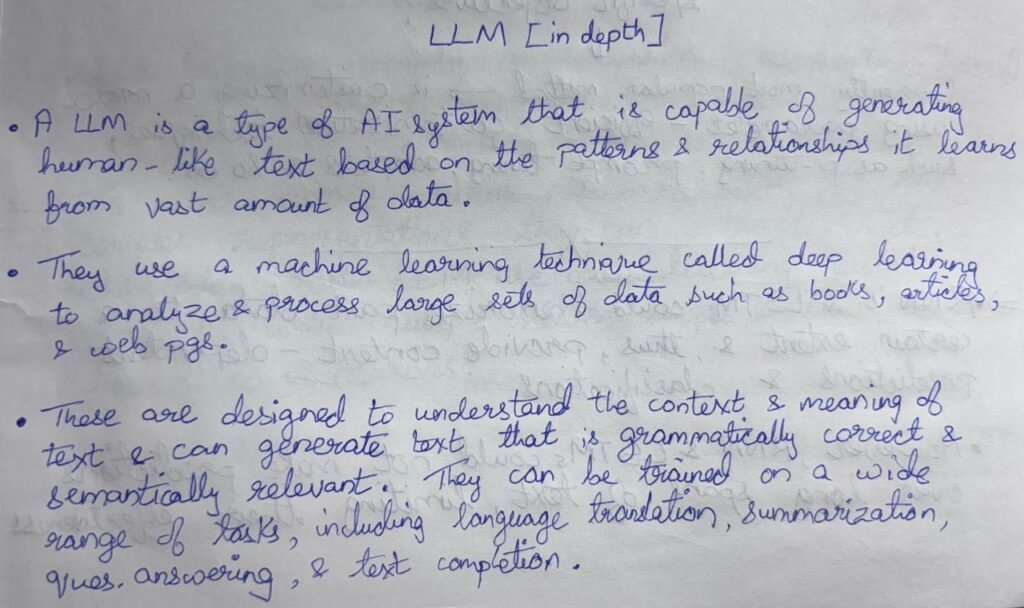
An LLM gets there through a technique called deep learning, fed a genuinely massive pile of text: books, articles, web pages, more or less anything written down and accessible at scale.
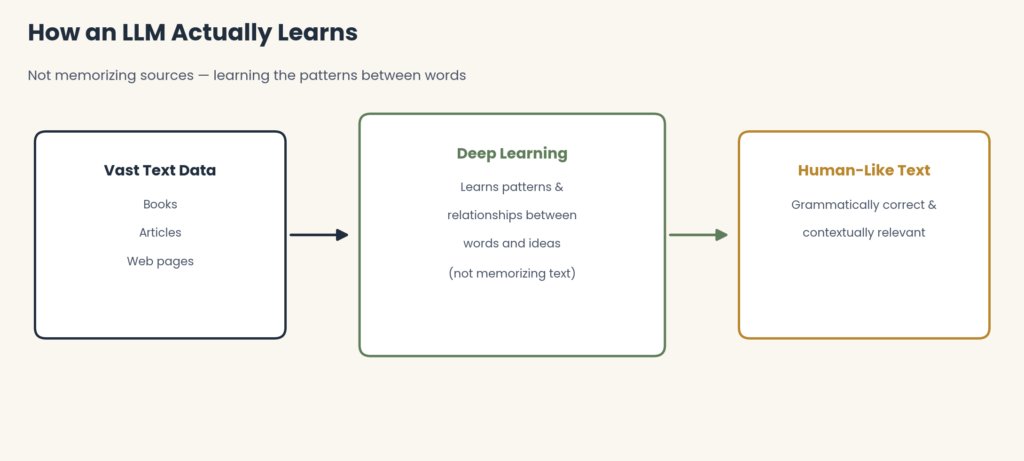
It isn’t memorizing those sources word for word. It’s learning which words tend to follow others, which ideas tend to sit near each other, how a sentence in this spot of a paragraph usually gets written.
Is this just a smarter search engine?
Worth pausing on, because the two get confused a lot.
A search engine finds pages that already exist and hands you links to them. It’s a librarian pointing at shelves.
An LLM doesn’t hand you an existing page. It generates a new sentence, one that didn’t exist in that exact form before you asked, built from patterns it picked up during training.
That’s why an LLM can answer something oddly specific in one clean paragraph, and also why it can sound completely confident while being wrong. It isn’t checking a source in real time. It’s producing what a good answer to this pattern of question usually looks like.
Ask a search engine for a substitute for buttermilk in a recipe, and you get ten blog posts to sift through, most of them padded with a life story before the actual answer. Ask an LLM the same thing, and you get one direct answer, assembled on the spot, no scrolling required.
Why it doesn’t just sound grammatically fine, it sounds right
Here’s the part that actually got me. An LLM isn’t just stitching together sentences that are grammatically correct in isolation. It’s built to track context and meaning across the whole response, so the output stays on-topic and reads as one coherent answer.
That tracking is also why it can hold a conversation. Mention something three messages ago, and a decent LLM will still remember it applies to your current question, the same way a person would, not because it re-reads the whole chat from scratch every time in some robotic way, but because context is part of what it’s built to carry forward.
That’s the difference between a random word generator and something that reads like it’s actually responding to you.
What that same system gets used for
Because of that, one underlying system ends up doing some pretty different jobs:
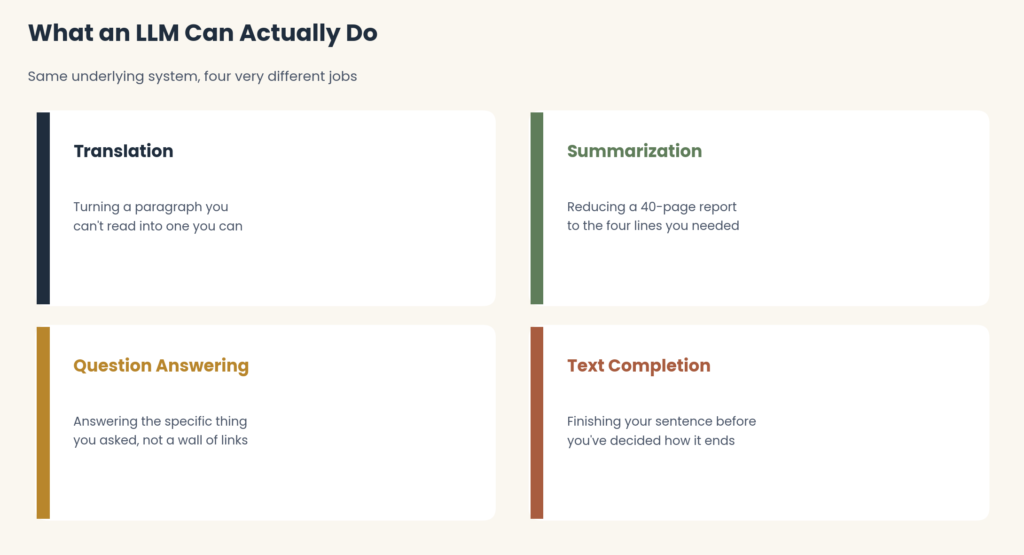
Translation — turning a paragraph you can’t read into one you can, without losing what it was trying to say.
Summarization — reducing a 40-page report into the four lines your professor actually wanted.
Question answering — answering the specific thing you asked, instead of handing you a wall of links to sort through yourself.
Text completion — finishing your sentence in an email or a message before you’ve fully decided how you wanted to end it.
Different outputs, same underlying trick: patterns learned from a huge amount of text, applied to whatever’s in front of it now.
You’ve probably used at least three of these this week without ever labeling them that way.
One honest catch, briefly
Because an LLM is producing what a good answer usually looks like, and not checking facts against a live source, it can be confidently, fluently wrong. The sentence reads just as smoothly whether it’s right or not.
That’s not a flaw I’ll unpack here. Just worth knowing before the next part, so nothing here reads like an LLM is infallible.
Where this leaves us
This is the surface version on purpose. I haven’t touched how an LLM actually decides, word by word, what comes next, or what changes once a general model gets pointed at one specific job. That’s for the next part, once I’ve worked through it properly myself.
If the embeddings piece made sense to you, this is the system that’s actually built on top of those embeddings. And if you’re wondering why something like this counts as a genuinely hard problem for AI rather than a solved one, this piece on task domains is the other half of that picture.
Before you go!
Connect with me